Written by Dr. Adriana Leone, DMD, founder of Wall Street Dental Spa
Laughing gas wears off within 5 to 10 minutes after the dentist turns off the gas and switches the patient to pure oxygen. Patients are usually braced for something much longer, the kind of recovery that follows other sedation. Instead they sit up, put their coat on, and head back to the office.
Most of the effect is gone within 5 to 10 minutes of the mask coming off, and the clock on that starts the moment I turn the gas down.
Here is the sequence from my chair.
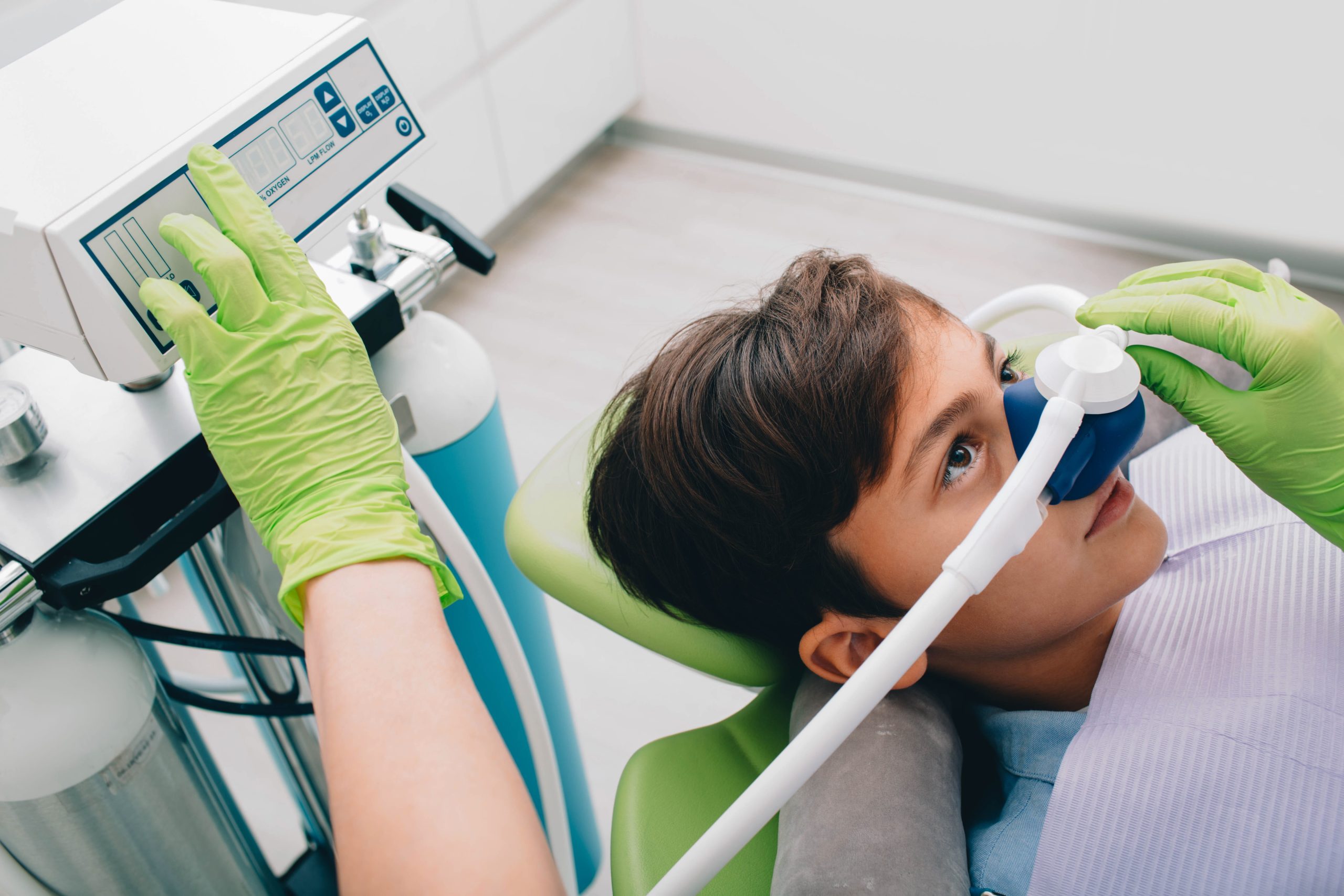
The nasal hood goes on first, and you breathe normally. The gas starts working in about 3 to 5 minutes, and you feel it as a warm heaviness or a light tingle in your hands and feet. I adjust the level up or down during treatment based on how you look and what you tell me.
When the dental work is done, I shut off the nitrous oxide and turn your oxygen to 100 percent. You keep the mask on for another five minutes while that oxygen clears the last of the gas out of your lungs. That five minutes is not padding. It is the part that determines whether you walk out feeling normal or with a dull headache.
Then the mask comes off, you sit up slowly, and we check that you are back to yourself before you leave. For most patients that whole tail end takes less time than the paperwork.
Nitrous oxide is the mildest option in our sedation dentistry lineup, and the short recovery is most of the reason people choose it.
The floaty, giggly part fades within a few minutes of the gas being switched off, and it is usually gone before you stand up. Some patients notice a mild lightheadedness for another 10 to 15 minutes. If you still feel off after that, tell your dental team rather than walking it off outside.
Nitrous oxide is the only sedation option that lets most patients drive themselves home the same hour. The table below is the comparison patients are really asking about when they ask how long the gas lasts.
| Type of sedation | How long until you are back to baseline | Can you drive yourself home? |
|---|---|---|
| Nitrous oxide (laughing gas) | 5 to 10 minutes | Yes, once your dental team confirms you are alert |
| Oral sedation | Hours, not minutes | No |
| IV sedation | Hours, not minutes | No |
| General anesthesia | Hours, not minutes | No |
A few things to know about that table:
Nitrous oxide leaves so fast because your body never breaks it down at all.
Most sedatives get absorbed, processed by the liver, and cleared over hours. Nitrous oxide skips that entirely. The gas travels in your blood as free gas, does not undergo biotransformation, and leaves through your lungs when you exhale. Its low solubility in blood is what lets it move out that quickly.
Think of the difference between a meal and a breath of cold air. One your body has to work through. The other is in and out, and a few minutes later there is no trace of it.
That single fact explains almost everything patients find surprising about laughing gas. Fast on, fast off, and no residue to sleep off.
Yes. Most patients can drive themselves home after nitrous oxide, and the Cleveland Clinic notes that its short-acting nature is exactly why. What I ask of my own patients is simple: wait until you feel completely clear-headed, and let us confirm it before you go.
That usually means sitting up for a few minutes after the mask comes off rather than jumping straight out of the chair. If you feel even slightly hazy, say so and stay a little longer. Nobody is rushing you out of the room.
If you had nitrous combined with anything else, the answer changes completely, and we will tell you that at the appointment rather than leaving you to guess.
Laughing gas relaxes you without putting you to sleep, and you stay awake and able to answer questions the whole time.
Patients describe a pleasant heaviness, a bit of tingling in the hands and feet, and a sense that the appointment is happening somewhere slightly to the left of them. You can hear me, respond to me, and follow instructions. You are not unconscious, and I am not going to be doing anything you are unaware of.
The name oversells the giggling, by the way. Some patients laugh. Plenty just relax and stare at the ceiling.
For anyone who has put off treatment because of nerves, the gas is often the thing that makes a first appointment possible. If it has been years, you can come back to dental care without judgment here.
Nitrous oxide raises your pain threshold rather than blocking pain outright, so it does not replace local anesthetic. For a filling or an extraction, you still get numbed. The gas handles the anxiety and takes the edge off sensation. Used together, the two cover far more than either does alone.
Feeling briefly drowsy is common, but genuine sleepiness should not carry into your afternoon. One study of patients after nitrous oxide inhalation found no evidence of increased sleepiness beyond one hour. If you are still fighting to stay awake hours later, something other than the gas is likely responsible, and your dentist should hear about it.
Ready to love your smile when you look in the mirror? Schedule your appointment today! Let us make you love your smile again!
Book Appointment | Call Today: 646-566-3307
When patients report lingering grogginess after laughing gas, the cause is usually the oxygen step being cut short rather than the gas hanging around.
There is a name for it. If the nitrous oxide is stopped and the patient goes straight back to room air, gas floods out of the blood into the lungs fast enough to dilute the oxygen they are breathing. Guidance from the American Academy of Pediatric Dentistry is to keep oxygen at 100 percent for no less than 3 to 5 minutes to avoid diffusion hypoxia, which can cause headache, nausea, or grogginess.
Handled properly, that whole problem disappears. It is the cheapest five minutes in dentistry and I never skip it.
Some patients do get mild side effects regardless, most often nausea, shivering, sweating, or dizziness. These tend to show up when the level ran a little high or when someone came in on an empty or very full stomach, and they settle quickly once the gas is off.
Red flags: tell your dental team right away if you notice any of the following after nitrous oxide.
Nitrous oxide suits mild to moderate dental anxiety and shorter appointments, and it stops being the right tool once either of those goes past a certain point.
Longer or more involved treatment often calls for something deeper, because holding a nasal hood in place for three hours is its own kind of unpleasant. Severe anxiety, a strong gag reflex, or a case that needs several procedures in one sitting usually points toward oral or IV sedation. Certain medical conditions rule nitrous out entirely, which is why we go through your history first rather than assuming.
Here is a common mix-up. Patients tell me they had laughing gas for wisdom teeth removal and woke up remembering nothing. In almost every case they had nitrous plus another agent, and the second one did the forgetting. Nitrous oxide on its own does not knock you out or erase the appointment.
Nitrous oxide is also used recreationally, and repeated unsupervised exposure is a different proposition from one monitored appointment. Sustained use has been linked to serious nerve damage, and the risk builds quietly rather than announcing itself. A dental visit with measured gas, oxygen, and someone watching you is not comparable, and I would not want anyone reading this to draw that conclusion.
If dental anxiety is the thing that has kept you out of a chair, the sedation conversation is a better place to start than the treatment conversation. We will talk through which option fits how you actually feel about the dentist, not just what the procedure requires.
Find the sedation option that fits you
I would rather you walk in knowing what to expect than spend a week bracing for it.
Nitrous oxide is out of your system within minutes. Your body does not metabolize it, so there is nothing to break down or store. You exhale it through your lungs, and the pure oxygen your dentist gives you afterward clears the remainder. Nothing lingers overnight or into the next day.
Laughing gas works for as long as you are breathing it. Your dentist controls the flow throughout the appointment and adjusts the level based on how you are doing. A 30 minute filling and a 90 minute appointment both stay covered. The effect ends when the gas does.
The American Dental Association describes inhaled nitrous oxide and oxygen as a safe and effective way to manage pain and anxiety in dentistry when used appropriately. Delivery systems carry at least 12 built-in safety features. Your dentist reviews your medical history first, because a small number of conditions make nitrous oxide unsuitable.
Laughing gas keeps you awake, aware, and able to talk. General anesthesia makes you fully unconscious and unable to be woken easily. Nitrous oxide sits at the mildest end of sedation, clears in minutes, and needs no driver. General anesthesia requires an escort and a recovery period.
Yes. Nitrous oxide does not cause memory loss, and most patients recall the appointment clearly, if a little hazily around the edges. Patients who remember nothing usually received another sedative alongside the gas. If losing the memory matters to you, ask your dentist about deeper sedation options.
Dr. Adriana Leone, DMD, is the founder of Wall Street Dental Spa in Manhattan’s Financial District. A graduate of Tufts University School of Dental Medicine, she has practiced dentistry since 1999 and opened her boutique practice in 2005. Dr. Leone is recognized among America’s Top Dentists and is one of New York City’s most experienced Invisalign providers, with more than 500 cases completed. She built Wall Street Dental Spa around calm, judgment-free, wellness-focused care for busy NYC professionals.
